
If you are searching for the best treatment for fatty liver disease while also trying to lose weight, one of the biggest questions today is Resmetirom vs Ozempic.
Both medications are now widely discussed for MASH/NASH fatty liver treatment, but they work in very different ways.
One directly targets the liver.
The other primarily targets weight loss and blood sugar.
So which one is better?
The answer depends on your goals:
- reducing liver fat and fibrosis
- reversing fatty liver disease
- losing body weight
- improving insulin resistance
In this guide, we compare GLP-1 vs Resmetirom in a simple, medically accurate way.
What Is Resmetirom?
Resmetirom (brand name Rezdiffra) is the first FDA-approved medication specifically developed for MASH (formerly NASH) with liver fibrosis.
It works as a thyroid hormone receptor beta (THR-β) agonist, acting mainly inside the liver to reduce:
- liver fat accumulation
- inflammation
- fibrosis progression
- cholesterol abnormalities
Clinical studies showed significant improvement in liver fat reduction and fibrosis markers in patients with moderate liver scarring. (Nature)
This makes it one of the most targeted treatments currently available for fatty liver disease treatment comparison searches.
What Is Ozempic?
Ozempic contains semaglutide, a GLP-1 receptor agonist.
It was originally approved for type 2 diabetes, but it became extremely popular because of its strong weight loss benefits.
Ozempic helps by:
- reducing appetite
- slowing stomach emptying
- improving insulin sensitivity
- lowering blood sugar
- supporting fat loss
Although the branded product itself is not marketed primarily as a weight-loss drug, semaglutide-based therapies are well known for substantial weight reduction. (Ozempic)
More recently, GLP-1 therapies have also shown strong benefits for fatty liver disease and MASH. (Nature)
Resmetirom vs Ozempic: Main Difference
The biggest difference is mechanism of action.
| Feature | Resmetirom | Ozempic |
|---|---|---|
| Primary purpose | Fatty liver treatment | Diabetes + weight loss |
| Main action | Works directly in liver | Works through appetite and metabolism |
| Weight loss effect | Mild to moderate | Strong |
| Liver fibrosis benefit | Strong direct evidence | Improving evidence |
| Diabetes benefit | Limited | Excellent |
Think of it like this:
- Resmetirom treats the liver directly
- Ozempic treats the metabolic cause behind fatty liver
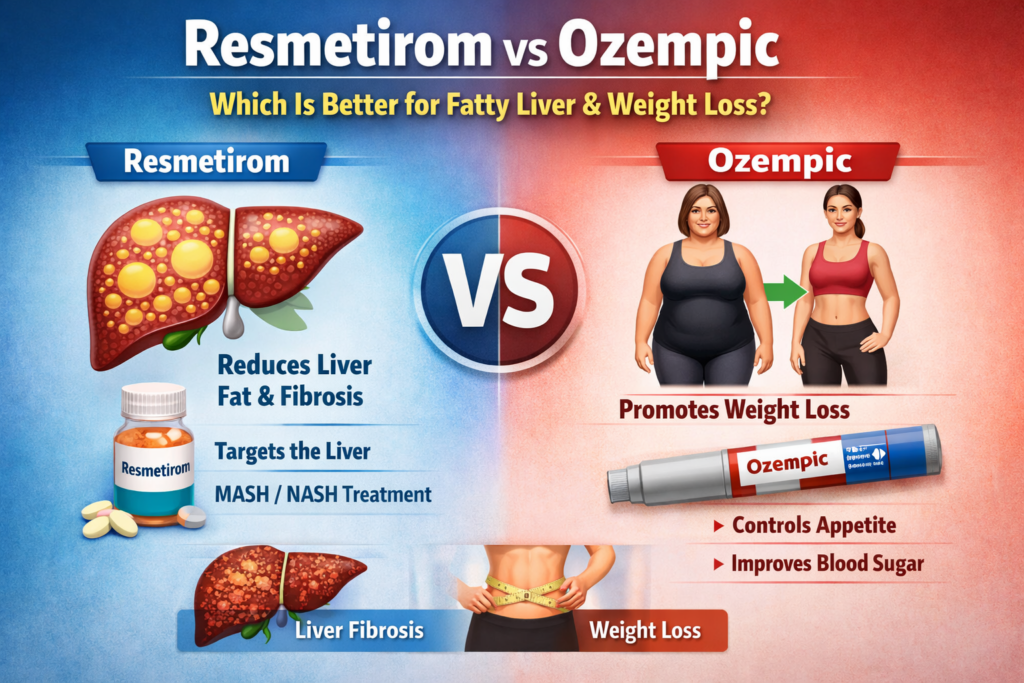
GLP-1 vs resmetirom.
Which Is Better for Fatty Liver?
For moderate to advanced MASH/NASH, Resmetirom currently has the advantage because it is specifically approved for this condition.
Studies show it significantly improves:
- liver fat percentage
- ALT / AST levels
- fibrosis scores
- MASH resolution rates (PMC)
However, semaglutide has also produced impressive results.
Recent trial data reported approximately:
- 62.9% MASH resolution
- 37% fibrosis improvement (Reddit)
This means Ozempic and other semaglutide drugs are becoming serious competitors in fatty liver management.
Best choice for fatty liver:
- Resmetirom → direct liver disease treatment
- Ozempic → fatty liver caused by obesity + insulin resistance
Many liver specialists now consider them complementary rather than competing treatments. (Nature)
Which Is Better for Weight Loss?
This is where Ozempic clearly wins.
Semaglutide-based medications are among the most effective prescription options for medical weight loss.
Average body weight reduction may range from 10–15% or more, depending on dose and duration.
Resmetirom is not primarily a weight loss drug.
Some patients may experience mild weight reduction because of improved metabolic liver function, but it is usually much less than Ozempic.
Winner for weight loss:
Ozempic
This is one of the strongest ranking opportunities for keywords like:
- resmetirom vs ozempic for weight loss
- ozempic for fatty liver and obesity
- best medicine for fatty liver and belly fat
Which Is Better for Insulin Resistance?
For insulin resistance, prediabetes, or type 2 diabetes, Ozempic is generally better.
Because fatty liver disease is strongly linked with insulin resistance, this gives semaglutide an important advantage in overweight patients.
Ozempic helps improve:
- fasting glucose
- HbA1c
- insulin sensitivity
- abdominal obesity
This often indirectly improves fatty liver as well. (Ozempic)
Side Effects Comparison
Resmetirom side effects
Common side effects may include:
- nausea
- diarrhea
- itching
- mild gastrointestinal discomfort (Reddit)
Ozempic side effects
Common side effects:
- nausea
- vomiting
- constipation
- acid reflux
- appetite suppression
- occasional fatigue (Ozempic)
Some people tolerate one medication better than the other.
Can They Be Used Together?
Emerging expert reviews suggest that Resmetirom + GLP-1 therapy may work extremely well together, especially in obese patients with MASH. (Nature)
Why?
Because one treats:
- liver fibrosis directly
and the other treats:
- body weight + insulin resistance
This combination approach may become increasingly common in 2026 and beyond.
Final Verdict: Which Is Better?
Here’s the simplest answer.
Choose Resmetirom if:
- your main issue is MASH/NASH with fibrosis
- liver scarring is the biggest concern
- your doctor wants targeted liver treatment
Choose Ozempic if:
- your main goal is weight loss
- you have insulin resistance or diabetes
- obesity is driving fatty liver disease
Best overall for both:
In many cases, the best answer may be both under specialist supervision.

After 38 Years of Medical Practice I have started to share insights from my experience over this blog. Know more about me here on About Page and Visit my LinkedIn profile.