
Nonalcoholic fatty liver disease (NAFLD) and its progressive form, nonalcoholic steatohepatitis (NASH), are among the most common liver conditions worldwide. These disorders are closely linked with obesity, insulin resistance, type 2 diabetes, and excess fat around the abdomen—often referred to by patients as belly fat.
With recent advances in pharmacotherapy, new drugs like Rezdiffra (resmetirom) have emerged as targeted treatments for fatty liver disease. As discussions about metabolic health grow, so do questions about how these medications affect the body beyond the liver.
One frequently asked question is:
Can Rezdiffra reduce belly fat in fatty liver patients?
In this comprehensive guide, we explore whether Rezdiffra has any meaningful effect on belly fat, how it works, what clinical evidence currently shows, and what relevant science says about body composition changes in patients treated with this medication.
This article is intended for educational purposes only and does not replace medical advice. Always consult a qualified healthcare professional about treatment decisions.
Section 1: Understanding Belly Fat and Fatty Liver Disease
What Is Belly Fat?
“Belly fat” is a lay term that usually refers to abdominal adiposity, which includes:
- Subcutaneous fat — the layer just under the skin
- Visceral fat — fat stored deep inside the abdominal cavity around internal organs
Visceral fat is the type most closely linked with metabolic disease, including:
- Insulin resistance
- Elevated triglycerides
- Elevated LDL cholesterol
- Inflammation
- Nonalcoholic fatty liver disease (NAFLD)
What Is Fatty Liver Disease?
NAFLD refers to excess fat accumulation in the liver not caused by alcohol use. It ranges from:
- Simple steatosis — fatty liver without significant inflammation
- Nonalcoholic steatohepatitis (NASH) — fatty liver with inflammation and fibrosis
NASH can progress to scarring (fibrosis), cirrhosis, and even liver cancer.
Key risk factors for NAFLD include:
- Obesity
- Type 2 diabetes
- Metabolic syndrome
- Central (abdominal) obesity
So when we talk about rezdiffra fatty liver weight loss or rezdiffra belly fat, we’re really asking whether Rezdiffra helps with metabolic changes associated with both liver fat and abdominal fat.
Section 2: What Is Rezdiffra and How Does It Work?
Rezdiffra (Resmetirom) — The Basics
Rezdiffra is the brand name for resmetirom, a selective thyroid hormone receptor beta (THR-β) agonist.
This drug was developed to target metabolic pathways in the liver, not the central nervous system or appetite centers of the brain.
FDA-Approved Use
Currently, Rezdiffra is FDA-approved for:
The treatment of nonalcoholic steatohepatitis (NASH) with fibrosis.
It is not approved for weight loss, obesity management, or any indication outside of NASH.
Mechanism of Action (Simplified)
Rezdiffra works by:
- Activating THR-β receptors in liver cells
- Enhancing liver fat metabolism
- Reducing the accumulation of hepatic fat
- Improving lipid profiles (e.g., lowering LDL cholesterol)
Unlike weight-loss drugs, Rezdiffra does not:
- Suppress appetite
- Act on hunger centers in the brain
- Directly increase energy expenditure
- Influence fat distribution beyond liver metabolism
This distinction is important when interpreting terms like rezdiffra belly fat and rezdiffra fatty liver weight loss.
Section 3: Belly Fat vs Liver Fat — The Difference
Liver Fat (Steatosis)
Liver fat refers to the accumulation of triglycerides within liver cells. This is what NAFLD and NASH evaluate.
Excess liver fat is associated with metabolic dysfunction, inflammation, and fibrosis.
Belly Fat (Central Adiposity)
Abdominal fat, especially visceral adipose tissue, is metabolically active and contributes to:
- Insulin resistance
- Chronic inflammation
- Elevated cardiovascular risk
- Progression of metabolic disease
While both liver fat and belly fat are related through systemic metabolism, they are distinct tissues with different physiological roles.
Reducing liver fat does not automatically mean significant loss of abdominal (belly) fat.
Section 4: Do Clinical Trials Show Rezdiffra Reduces Belly Fat?
Trial Design Focus
Most Rezdiffra clinical trials are designed to measure:
- Reduction in liver fat (via imaging or biopsy)
- Improvement in liver histology (NASH resolution)
- Changes in fibrosis
They are not primarily designed to assess body composition changes like:
- Visceral fat reduction
- Subcutaneous fat loss
- Waist circumference changes
Thus, evidence directly addressing rezdiffra belly fat reduction is limited.
Weight Change Observed in Trials
Some trials have reported:
- Modest weight changes in subsets of participants
- Variable individual responses
- No consistent, statistically significant weight loss across study populations
However:
- Weight change was usually a secondary or exploratory observation
- Trials were not powered to detect changes in abdominal fat
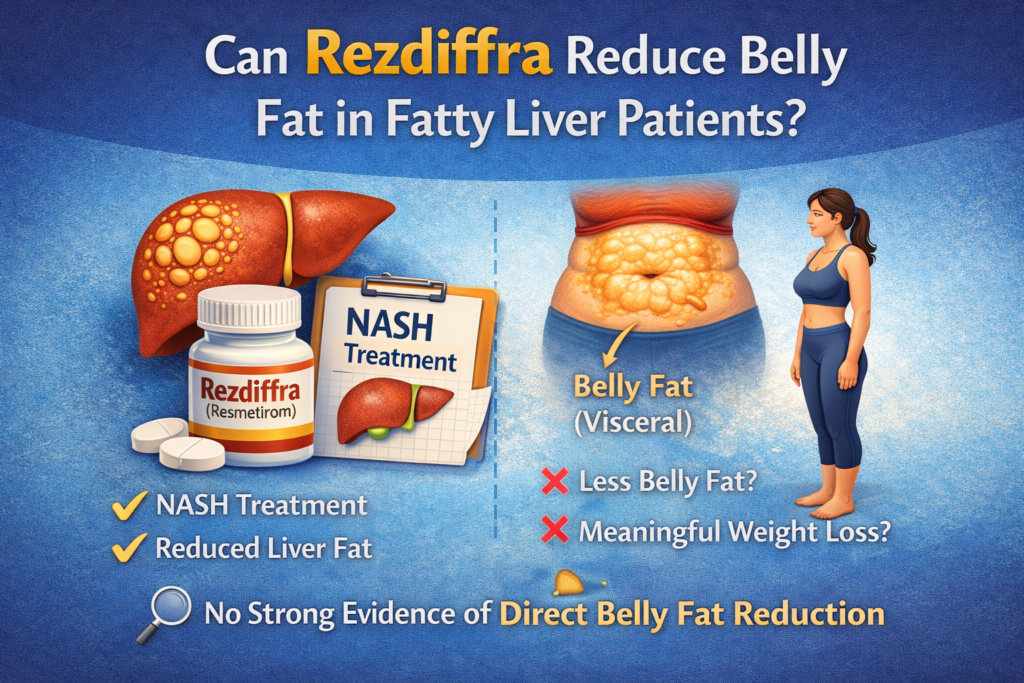
Therefore, no clinical trial to date provides robust evidence that Rezdiffra directly reduces belly fat.
Section 5: How Might Rezdiffra Influence Body Fat Indirectly?
Even though Rezdiffra isn’t designed to act on belly fat, metabolic improvements in the liver can sometimes have downstream effects on overall metabolism.
Here’s how:
1. Improved Liver Metabolism
Reducing hepatic fat can:
- Improve insulin sensitivity
- Reduce inflammation
- Improve lipid profiles
These changes may improve systemic metabolism and can, over time, contribute to modest changes in body composition.
2. Improved Lipid Handling
Better fat processing in the liver may reduce circulating triglycerides and improve how the body stores fat overall.
However, this is a systemic metabolic effect, not a targeted reduction of abdominal fat.
Section 6: Why Liver Fat Reduction Doesn’t Always Correlate With Belly Fat Loss
While both liver fat and belly fat are features of metabolic dysfunction, they are distinct processes:
- Liver fat accumulation is a cellular process within hepatocytes
- Belly fat is adipose tissue stored around the abdomen
Medications that improve liver fat may not directly reduce visceral adiposity unless they also affect:
- Appetite regulation
- Energy balance
- Central metabolic pathways
Rezdiffra’s mechanism is liver-focused, so any reduction in belly fat is likely indirect and modest.
Section 7: Other Medications With Demonstrated Effects on Belly Fat
To put the question into perspective, some other medication classes have more direct evidence of affecting visceral fat:
GLP-1 Receptor Agonists
Examples:
- Ozempic (semaglutide)
- Wegovy (higher-dose semaglutide)
- Mounjaro (tirzepatide)
These agents:
- Reduce appetite
- Slow gastric emptying
- Improve insulin sensitivity
- Often lead to clinically meaningful reductions in body weight
- Have shown reductions in visceral adiposity in some studies
However:
- These medications are not specifically liver drugs
- Weight loss is a primary or secondary endpoint in trials
In contrast:
- Rezdiffra is a liver-specific metabolic agent
- Weight change and body composition changes are not primary endpoints
Section 8: Real-World Observations
Some patients taking Rezdiffra may notice:
- Slight changes in weight
- Improved energy or metabolism
- Improvements in metabolic markers
However, these observations:
- Are often individualized
- May be influenced by concurrent lifestyle changes (diet, exercise)
- Are not consistent across large trial populations
There is no strong evidence to suggest Rezdiffra reliably reduces belly fat in most patients.
Section 9: Can Rezdiffra Help With Fatty Liver AND Weight Loss?
Fatty Liver Improvement
Yes — clinical evidence supports that Rezdiffra reduces liver fat and improves liver histology in NASH patients.
Weight Loss or Belly Fat Reduction
Not reliably.
While metabolic improvements can positively influence overall health, Rezdiffra does not have a mechanism that directly targets weight or visceral fat.
Some patients may experience:
- Small, indirect weight changes
- Improved lipid parameters
- Better metabolic profiles
But significant belly fat reduction is not a well-documented effect.
Section 10: What Patients Should Expect
Patients taking Rezdiffra should realistically expect:
- Potential improvements in liver fat and inflammation
- Improved blood lipid profiles
- Better markers of cardiometabolic health
Patients should not expect:
- Guaranteed weight loss
- Significant reductions in belly fat
- Appetite suppression
- Effects similar to weight-loss medications
Section 11: Lifestyle Still Matters
Even when taking medications like Rezdiffra:
Diet and Nutrition
A balanced diet tailored to metabolic health supports:
- Insulin sensitivity
- Fat distribution
- Overall energy balance
Physical Activity
Exercise contributes to:
- Reduced visceral adiposity
- Improved metabolic health markers
- Better body composition outcomes
Sleep and Stress
Poor sleep and chronic stress can:
- Increase visceral fat storage
- Impair metabolic processes
Medications like Rezdiffra work best when combined with:
- Evidence-based lifestyle modifications
- Professional guidance from healthcare providers
Section 12: Common Questions (SEO FAQ)
1. Does Rezdiffra reduce belly fat?
There is no strong clinical evidence that Rezdiffra significantly or directly reduces belly fat. Any changes in abdominal adiposity are likely modest and indirect.
2. Can Rezdiffra cause weight loss?
Weight changes in trials were variable and not a consistent or primary outcome. Rezdiffra is not designed for weight loss.
3. Is Rezdiffra effective for fatty liver patients?
Yes — Rezdiffra has demonstrated effectiveness in reducing liver fat and improving NASH histology.
4. Does reducing liver fat mean belly fat will also reduce?
Not necessarily. While related through systemic metabolism, liver fat and belly fat are distinct and do not always change in parallel.
5. Should Rezdiffra be used for weight loss?
No — Rezdiffra is not approved for weight loss or obesity treatment.
Section 13: Key Takeaways
- Rezdiffra is designed to improve liver metabolism, not target belly fat.
- Rezdiffra improves liver fat, histology, and metabolic markers in NASH.
- Clinical evidence does not strongly support belly fat reduction as a drug effect.
- Any observed weight or fat changes are likely indirect and modest.
- Lifestyle factors remain essential for overall metabolic health.
Section 14: Medical Disclaimer
This article is for educational purposes only and does not provide medical advice, diagnosis, or treatment recommendations. Always consult a qualified healthcare professional before starting or changing any medication or treatment.
Section 15: Final Thoughts
The question of whether Rezdiffra can reduce belly fat in fatty liver patients is understandable given the link between metabolic disease and central adiposity. However, current evidence shows that while Rezdiffra has meaningful effects on liver health, it does not have a primary or reliable effect on belly fat or weight loss.
For patients and clinicians alike, it’s important to recognize the difference between:
- Liver-targeted metabolic improvements
- Whole-body weight regulation
Recognizing this distinction encourages realistic expectations and supports appropriate use of medications within their evidence-based indications.