
As the landscape of metabolic health treatments expands, medications originally developed for specific conditions are increasingly discussed in broader contexts, including weight management. One such medication is Rezdiffra (resmetirom)—a liver-targeted therapy recently approved for certain stages of nonalcoholic steatohepatitis (NASH).
A common and important question that often arises among patients and practitioners is:
“Is Rezdiffra safe for long-term weight loss?”
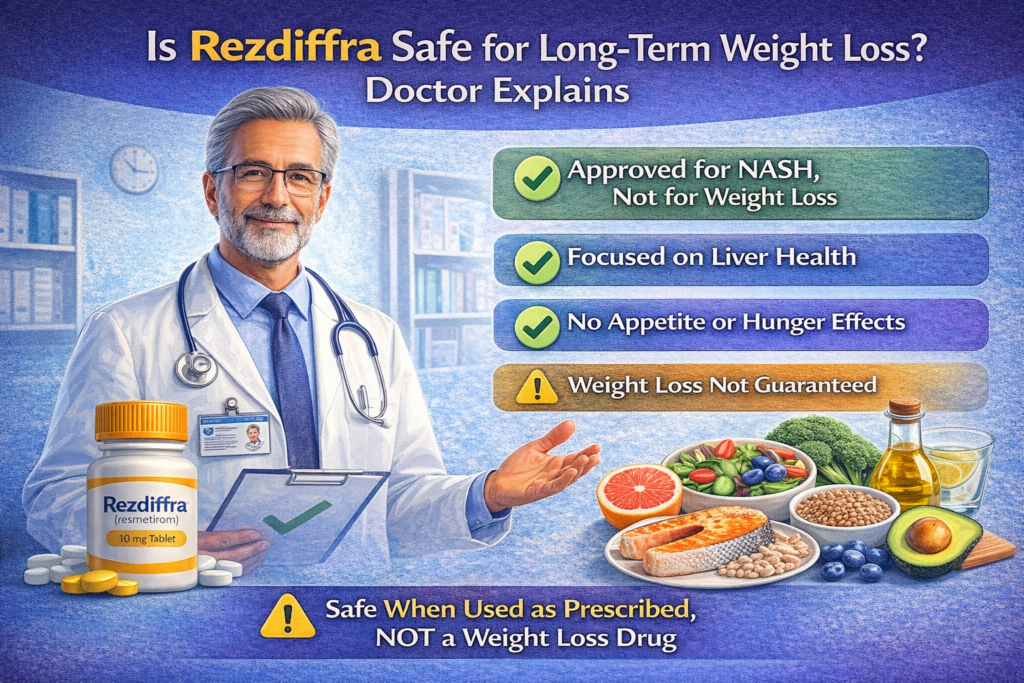
This question reflects the widespread interest in achieving healthier body weight. However, it requires careful clarification because Rezdiffra is not approved as a weight-loss medication. Understanding the difference between a drug’s approved indication and its observed metabolic effects is essential for safe, appropriate use.
In this article, we will explore:
- What Rezdiffra is designed to do
- What clinical evidence shows about weight changes
- Safety considerations for long-term use
- The difference between liver-focused therapy and weight-loss therapies
- Why “weight loss” should not be the primary expectation with Rezdiffra
This content is educational only and does not substitute professional medical advice. Always consult a qualified healthcare provider before starting or changing any medication.
Section 1: What Rezdiffra Is (and What It Is Not)
What Rezdiffra Is
Rezdiffra is the brand name for resmetirom, a selective thyroid hormone receptor beta (THR-β) agonist. It is designed to act primarily in the liver, where THR-β receptors are densely expressed.
Rezdiffra was developed to:
- Reduce liver fat accumulation
- Improve liver histology (microscopic tissue structure)
- Slow or reverse fibrosis progression in adults with NASH
What Rezdiffra Is Not
Rezdiffra is not:
- A weight-loss drug
- Approved for obesity or metabolic syndrome
- A medication that directly suppresses appetite
- A systemic thyroid hormone replacement
This distinction is critical because safety evaluations for medications differ depending on their intended use. Drugs approved for weight loss, such as GLP-1 receptor agonists, are tested specifically for long-term weight-related outcomes—Rezdiffra is not.
Section 2: How Rezdiffra Works — Focus on the Liver
To understand safety concerns, it helps to know how Rezdiffra works.
Mechanism of Action
Rezdiffra selectively activates thyroid hormone receptor beta (THR-β), predominantly in liver tissue. Activation of THR-β results in:
- Enhanced hepatic fat oxidation
- Reduced lipid accumulation in liver cells
- Improvements in blood lipid profiles (e.g., reduced LDL cholesterol)
- Potential improvements in insulin sensitivity
This mechanism aims to address the underlying liver pathology in NASH, not to regulate body weight directly.
Section 3: Why People Associate Rezdiffra With Weight Changes
Because Rezdiffra affects liver fat metabolism and may improve systemic metabolic markers, some patients report modest changes in body weight or fat distribution. However:
- These observations are secondary to liver metabolic changes
- Weight is not a primary endpoint in clinical trials of Rezdiffra
- The drug is not designed to act on appetite or energy balance centers in the brain
Understanding this helps clarify why discussions about long-term safety in the context of weight loss require careful nuance.
Section 4: What Clinical Trials Say About Weight Change
Weight Was Not a Primary Endpoint
Large clinical trials for Rezdiffra (e.g., MAESTRO-NASH) were designed to assess:
- Improvement in liver histology
- Reduction of steatosis
- Changes in fibrosis stages
- Safety and tolerability
Weight measurements were included as part of safety monitoring, not as a primary or key secondary outcome.
Observed Weight Changes
Data from clinical trials show that:
- Some patients had small, incidental weight changes
- Weight changes were variable and not consistent across all participants
- No pattern emerged that would qualify Rezdiffra as a weight-loss agent
This reinforces the point that Rezdiffra is not approved nor proven for weight management, though some patients report changes during therapy.
Section 5: Safety Profile of Rezdiffra
FDA approval and clinical trial data provide information on safety, but it is essential to contextualize this within the intended use.
Commonly Reported Side Effects
In published trial results and safety summaries, some of the more commonly reported effects include:
- Gastrointestinal symptoms (e.g., mild nausea, diarrhea)
- Headache or fatigue in some individuals
- Changes in liver enzyme levels (monitored by healthcare providers)
These side effects are consistent with many medications that influence metabolic pathways and are typically monitored through routine clinical follow-up.
What Is Not Typically Reported
Rezdiffra use has not been consistently linked with:
- Severe weight loss
- Appetite suppression
- Muscle wasting
- Metabolic derangements outside the liver
This is important because medications that induce weight loss often have a different safety profile.
Section 6: Long-Term Safety — What We Know So Far
Because Rezdiffra is relatively new in clinical practice, long-term data are still accumulating, but the safety profile in available studies appears consistent with controlled expectations for liver-directed therapy.
Key Considerations
- Liver Function Monitoring: Regular liver enzyme testing is standard to ensure therapy is well-tolerated.
- Lipid Profile Changes: Rezdiffra has been shown to improve LDL cholesterol and other lipid parameters, which is generally considered favorable for cardiovascular risk.
- Metabolic Effects: Any metabolic changes (e.g., modest weight fluctuation) are not primary effects and are not tested as part of long-term safety endpoints.
In contrast to weight-loss medications where long-term weight outcomes and cardiovascular safety are primary endpoints, Rezdiffra’s safety focus remains on liver health and organ-specific metabolic markers.
Section 7: Appetite and Energy Balance — Why They Matter
One reason patients ask about safety in the context of weight loss is the concern that some medications suppress appetite or shift energy balance dramatically, potentially leading to:
- Nutritional deficiencies
- Muscle loss
- Unintended weight loss
- Electrolyte imbalance
Rezdiffra does not act on central appetite mechanisms and has not been linked to significant changes in hunger, eating behavior, or rapid weight changes in trials.
This is an important point in evaluating long-term safety: medications that suppress appetite often require different safety monitoring than drugs like Rezdiffra that do not.
Section 8: Safety in Special Populations — What We Know
People with Diabetes
Because of the overlap between NAFLD/NASH and type 2 diabetes, some patients may be taking multiple medications. Rezdiffra’s liver-focused mechanism does not generally interfere with glucose-lowering drugs, but clinicians monitor appropriately.
Older Adults
Older adults can be more sensitive to metabolic changes. While Rezdiffra has not shown adverse safety trends in older populations, regular monitoring is recommended to ensure liver health and overall metabolic stability.
People With Cardiovascular Risk
Rezdiffra’s favorable impact on lipid profiles may be beneficial, but cardiovascular safety should always be assessed individually, as with any metabolic therapy.
Section 9: Evaluating “Weight Loss Safety” Versus “Medication Safety”
Understanding the difference between safety concerning weight loss and general medication safety is critical.
Weight Loss Safety
Medications approved for weight management are rigorously tested for:
- Sustained weight reduction
- Cardiovascular outcomes
- Long-term metabolic safety
- Appetite effects
- Hormonal interactions
Examples include:
- GLP-1 receptor agonists
- SGLT2 inhibitors (in some contexts)
- Central appetite modulators
These drugs have safety considerations specific to weight change.
Medication Safety
Rezdiffra’s safety profile pertains to:
- Liver function
- Cholesterol and lipid metabolism
- Gastrointestinal tolerability
- Overall metabolic markers
It is not optimized or studied as a weight-control agent.
Thus, when asking “is Rezdiffra safe for weight loss?” we must distinguish:
- Is Rezdiffra safe as a medication?
— Yes, for its approved use in NASH, when monitored appropriately. - Is it safe to expect weight loss from Rezdiffra?
— No, because it is not approved for that purpose, and clinical trials do not support it.
Section 10: What Patients Should Expect — Realistic Perspectives
When patients start Rezdiffra, they should understand:
Expected Outcomes
- Improvement in liver fat measurements
- Favorable changes in lipid profiles
- Potential improvement in liver histology
Possible Secondary Observations
- Mild, variable weight changes (no guarantee)
- Improved metabolic biomarkers, if lifestyle changes occur
- Better quality of life through comprehensive care
What they should not expect:
- Rapid or predictable weight loss
- Appetite suppression
- A metabolic effect equivalent to obesity drugs
Section 11: Diet and Lifestyle — The Real Partners in Weight Regulation
Since Rezdiffra itself is not a weight-loss drug, patients often ask:
If I want to lose weight while taking Rezdiffra, what should I do?
The answer is:
- Balanced nutrition
- Regular physical activity
- Sleep optimization
- Stress management
- Regular health checkups
These elements remain the cornerstone of long-term weight management, regardless of medication.
Section 12: Safety Precautions and When to Contact a Provider
As with any medication:
- Report unexplained weight changes
- Monitor liver enzymes as recommended
- Discuss any gastrointestinal symptoms
- Evaluate other metabolic medications you may be taking
Prompt communication with a healthcare provider ensures safe, personalized care.
Section 13: SEO-Optimized FAQ
Q1: Is Rezdiffra safe to take long term?
Yes — for its approved indication (NASH with fibrosis) under medical supervision with appropriate monitoring. Long-term safety data continue to accumulate.
Q2: Does Rezdiffra cause weight loss?
Rezdiffra is not approved for weight loss, and clinical trials do not support consistent weight loss as a drug effect.
Q3: Can Rezdiffra be used for obesity treatment?
No. It is designed for liver metabolic disease and not indicated for obesity or weight control.
Q4: What side effects should I watch for?
Monitor liver function tests, and report any unexplained symptoms to your healthcare provider.
Q5: Does Rezdiffra affect appetite?
No. Rezdiffra does not act on appetite centers or hunger hormones.
Section 14: Key Takeaways
- Rezdiffra is safe when used for its approved indication under medical supervision
- It is not a weight-loss agent
- Weight changes observed in some people are incidental, not consistent
- Long-term safety data focus on liver outcomes and metabolic markers
- Weight outcomes should be managed through evidence-based diet and lifestyle
Medical Disclaimer
This article is for educational purposes only and does not substitute professional medical advice. Always consult a qualified healthcare provider before starting, stopping, or changing any medication or treatment approach.
Final Thoughts
Questions about “is Rezdiffra safe for weight loss?” raise essential discussions about how medications are perceived versus how they are studied and approved. Rezdiffra’s strengths lie in treating liver disease and improving metabolic markers in that context. Equating it with drugs designed for weight loss can lead to unrealistic expectations and misinterpretation of safety data.
Understanding the science behind the drug and its approved use helps patients, caregivers, and clinicians make informed decisions that prioritize health — not just weight.

After 38 Years of Medical Practice I have started to share insights from my experience over this blog. Know more about me here on About Page and Visit my LinkedIn profile.