
Rezdiffra (resmetirom) is increasingly discussed in medical and patient communities—not as a weight-loss drug, but as a metabolic therapy for nonalcoholic steatohepatitis (NASH). Yet many patients and clinicians have observed an intriguing pattern: some individuals experience modest weight changes while taking Rezdiffra, even though the drug does not suppress appetite.
This raises a key question:
Why does Rezdiffra appear to influence weight in some people without reducing hunger or food intake?
To answer this properly, we must move beyond marketing claims and social media anecdotes and examine the rezdiffra weight loss mechanism from a scientific and clinical perspective.
This article explains:
- How Rezdiffra works at the cellular level
- Why appetite is not affected
- How liver-specific metabolic changes may indirectly influence weight
- Why observed weight loss is usually modest and variable
- What patients should realistically expect
This content is educational only and does not replace professional medical advice.
Section 1: What Rezdiffra Is Designed to Do
What Is Rezdiffra?
Rezdiffra is the brand name for resmetirom, a selective thyroid hormone receptor-beta (THR-β) agonist.
Its therapeutic target is the liver, not the brain, gut, or appetite centers.
FDA-Approved Use
Rezdiffra is approved for:
Treatment of nonalcoholic steatohepatitis (NASH) with liver fibrosis in adults
It is not approved for:
- Weight loss
- Obesity management
- Appetite control
Understanding this distinction is crucial before exploring how Rezdiffra may still influence body weight.
Section 2: Appetite vs Metabolism — A Critical Distinction
Most people associate weight loss with:
- Reduced hunger
- Smaller portion sizes
- Feeling full sooner
This is how GLP-1 receptor agonists and other obesity drugs work.
Rezdiffra works differently.
Rezdiffra Does NOT:
- Act on the hypothalamus
- Alter hunger hormones (ghrelin, leptin)
- Slow gastric emptying
- Create early satiety
Yet some patients experience modest weight changes. This can only be explained by metabolic efficiency, not appetite suppression.
Section 3: Understanding the Rezdiffra Weight Loss Mechanism
The rezdiffra weight loss mechanism is indirect and liver-centric.
Key Principle
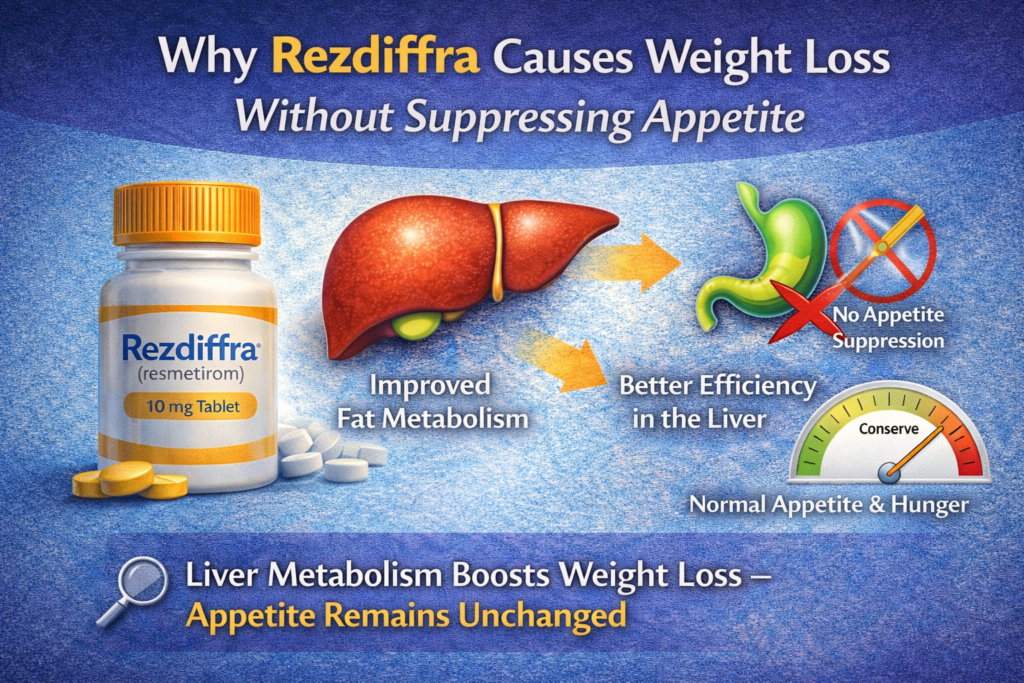
Rezdiffra improves how the liver processes fat and energy, not how much food a person eats.
This distinction separates it from conventional weight-loss drugs.
Section 4: Thyroid Hormone Receptor-Beta Activation Explained
Thyroid Hormone Basics
Thyroid hormones regulate:
- Basal metabolic rate
- Fat oxidation
- Cholesterol metabolism
- Energy utilization
However, non-selective thyroid hormone stimulation causes:
- Heart rhythm problems
- Bone loss
- Muscle wasting
Rezdiffra avoids these risks by selectively activating THR-β receptors, which are concentrated in the liver.
Why Liver-Specific Action Matters
By acting primarily in the liver, Rezdiffra:
- Increases hepatic fat oxidation
- Reduces fat accumulation in liver cells
- Improves lipid export and breakdown
These changes improve metabolic efficiency, not appetite.
Section 5: Liver Fat Reduction and Energy Balance
The Liver as a Metabolic Hub
The liver controls:
- Fat storage vs fat burning
- Glucose release
- Cholesterol synthesis
- Triglyceride handling
When the liver is overloaded with fat (as in NASH):
- Metabolism becomes inefficient
- Fat spills into circulation
- Insulin resistance worsens
Rezdiffra helps reverse this process.
How This Can Affect Weight
Improved liver metabolism can:
- Reduce abnormal fat storage signals
- Improve insulin sensitivity
- Normalize lipid handling
These changes may:
- Reduce slow, chronic fat accumulation
- Lead to gradual body composition shifts
This is not rapid or dramatic weight loss, but subtle metabolic recalibration.
Section 6: Why Appetite Remains Unchanged
One of the most misunderstood aspects of the rezdiffra weight loss mechanism is why hunger doesn’t decrease.
No Central Nervous System Action
Rezdiffra:
- Does not cross the blood-brain barrier significantly
- Does not stimulate appetite control centers
- Does not alter reward-based eating
Patients generally report:
- Normal hunger levels
- Normal meal sizes
- No food aversion
Any weight change happens despite normal eating, not because of reduced intake.
Section 7: Fat Oxidation vs Calorie Restriction
Traditional Weight Loss
- Eat less → burn stored fat
Rezdiffra-Associated Changes
- Eat the same → liver processes fat more efficiently
This distinction explains why:
- Weight loss is modest
- Changes are slow
- Results vary widely between individuals
Section 8: Why Weight Loss Is Inconsistent
Not all patients experience weight change on Rezdiffra.
Reasons include:
- Differences in baseline liver fat
- Severity of insulin resistance
- Dietary habits
- Physical activity levels
- Genetics
Rezdiffra improves metabolic pathways, but does not override lifestyle factors.
Section 9: Water Weight vs Fat Loss
Some early weight changes may be due to:
- Reduced hepatic inflammation
- Changes in glycogen storage
- Fluid shifts
These can appear as:
- Small scale changes
- Early “loss” that plateaus
This should not be mistaken for sustained fat loss.
Section 10: Rezdiffra vs Appetite-Suppressing Drugs
| Feature | Rezdiffra | GLP-1 Drugs |
|---|---|---|
| Appetite suppression | ❌ No | ✅ Yes |
| Brain action | ❌ No | ✅ Yes |
| Primary target | Liver | Gut + brain |
| Weight loss approval | ❌ No | ✅ Yes |
| Weight change | Modest, variable | Predictable |
This comparison reinforces why Rezdiffra should not be marketed or expected as a weight-loss drug.
Section 11: Why Some Patients Still Lose Weight
Weight loss on Rezdiffra often reflects:
- Improved insulin sensitivity
- Increased spontaneous activity due to better energy
- Health-motivated lifestyle changes
- Dietary compliance after diagnosis
These are indirect effects, not pharmacologic appetite suppression.
Section 12: Muscle Mass Preservation
Unlike hyperthyroid states, Rezdiffra:
- Does not significantly increase muscle breakdown
- Does not cause muscle wasting in trials
This helps explain why:
- Weight loss, when present, is usually mild
- Strength and energy are preserved
Section 13: Clinical Trial Perspective
Clinical trials show:
- Significant liver fat reduction
- Improved fibrosis markers
- Favorable lipid changes
They do not show:
- Large average weight loss
- Appetite suppression patterns
- Dose-dependent weight reduction
This confirms the indirect nature of the rezdiffra weight loss mechanism.
Section 14: Patient Expectations in 3–6 Months
Patients may experience:
- Improved liver biomarkers
- Better cholesterol levels
- Stable appetite
- Possible small weight change (up or down)
Weight loss is not guaranteed and should not be the primary treatment goal.
Section 15: SEO-Optimized FAQs
Why does Rezdiffra cause weight loss without appetite suppression?
Rezdiffra improves liver fat metabolism and energy utilization rather than acting on hunger pathways, leading to indirect and variable weight changes.
Is Rezdiffra a weight-loss drug?
No. Rezdiffra is approved for NASH treatment, not weight loss.
Does everyone lose weight on Rezdiffra?
No. Weight changes vary widely and are often minimal.
Can Rezdiffra be combined with weight-loss medications?
This decision should be made by a healthcare professional based on individual metabolic needs.
Section 16: Safety and Monitoring
Because Rezdiffra influences metabolic pathways, clinicians monitor:
- Liver enzymes
- Lipid profiles
- Overall tolerance
Any unexplained or rapid weight change should be evaluated medically.
Key Takeaways
- The rezdiffra weight loss mechanism is liver-driven, not appetite-driven
- Weight changes are indirect, modest, and variable
- Appetite suppression does not occur
- Liver metabolic efficiency improves
- Rezdiffra is not a substitute for obesity treatment
Medical Disclaimer
This article is for educational purposes only and does not constitute medical advice. Rezdiffra should only be used under the guidance of a qualified healthcare professional.
Final Thoughts
Rezdiffra represents a new class of metabolic liver therapy, not a traditional weight-loss medication. Any weight changes observed are best understood as a secondary effect of improved liver metabolism, not as appetite suppression or fat-burning action.
By understanding the true rezdiffra weight loss mechanism, patients and clinicians can set realistic expectations and focus on what Rezdiffra does best: improving liver health and metabolic function.

After 38 Years of Medical Practice I have started to share insights from my experience over this blog. Know more about me here on About Page and Visit my LinkedIn profile.