
How to Balance Fitness, Family, and Work Without Burning Out
Turning 30 changes how your body responds to stress, recovery, and routine. Add a demanding job, family responsibilities, and mental fatigue—and fitness often becomes the first thing to fall off the schedule.
That’s why Philip DeFranco’s fitness and weight loss journey resonates strongly with people over 30. His transformation wasn’t about chasing peak performance or extreme aesthetics. Instead, it reflected a longevity-focused mindset—training in a way that supports energy, consistency, and long-term sustainability.
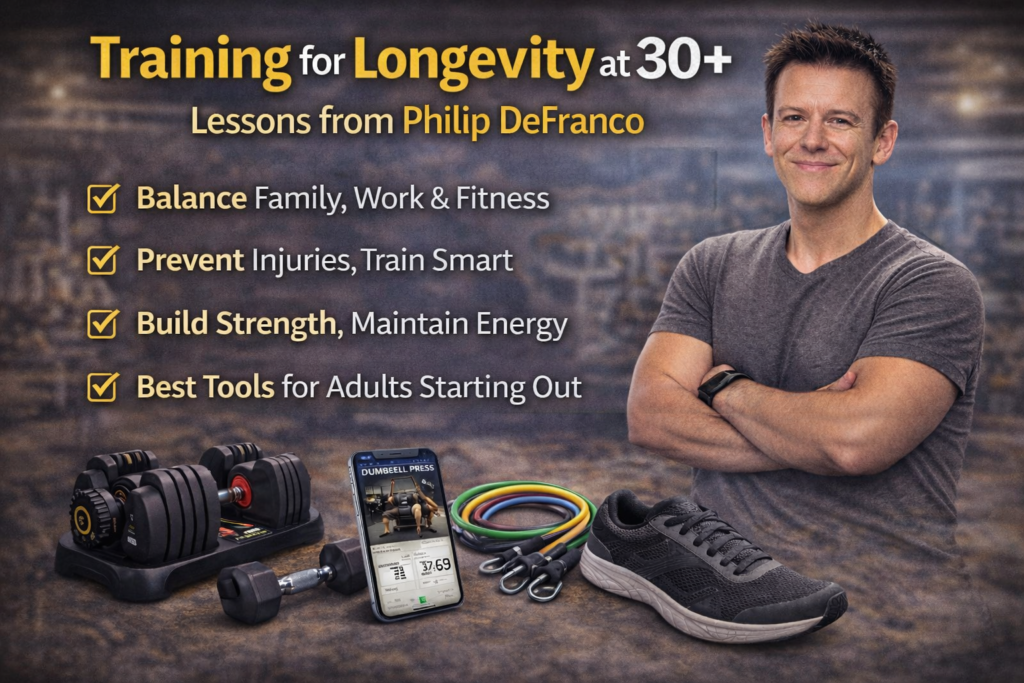
Philip DeFranco’s fitness approach highlights how weight loss and longevity can coexist when done correctly. In this article, we’ll explore training for longevity after 30, using lessons inspired by Philip DeFranco’s approach to fitness, balance, and consistency.
You’ll learn:
- How to balance workouts with work and family life
- Why injury prevention matters more than intensity
- How sustainable strength training supports long-term health
- The best beginner-friendly tools for adults starting fitness after 30
This isn’t about turning back the clock. It’s about building strength that lasts.
Why Fitness After 30 Requires a Different Approach
In your teens and twenties, fitness often revolves around:
- Pushing limits
- Recovering quickly
- Training through fatigue
After 30, the equation changes.
Common shifts include:
- Slower recovery
- Higher impact of stress and sleep
- Less free time
- Increased injury risk from poor movement
Philip DeFranco’s training evolution mirrors what many adults experience—moving away from extremes and toward repeatable habits.
What “Training for Longevity” Really Means
Training for longevity is not about:
- Maximal lifts
- Exhausting daily workouts
- Chasing short-term results
It’s about:
- Preserving strength
- Supporting joint health
- Maintaining mobility
- Building habits you can keep for decades
Longevity-focused training prioritizes consistency over intensity.
PART 1: Lessons from Philip DeFranco’s Fitness Approach After 30
Lesson 1: Fitness Must Fit Around Life — Not Replace It
Philip DeFranco didn’t restructure his entire life to work out. Instead, fitness fit into:
- A demanding content schedule
- Family responsibilities
- Daily work stress
This is a critical lesson for adults over 30.
Why This Matters
If your fitness plan requires:
- Multiple hours per day
- Perfect scheduling
- Constant motivation
It will eventually fail.
Longevity lesson:
Fitness should support your life—not compete with it.
Lesson 2: Consistency Beats “All-In” Phases
Rather than cycling through intense phases followed by burnout, DeFranco’s visible progress reflected:
- Moderate workouts
- Repeated weekly routines
- Long-term adherence
Many adults over 30 struggle because they treat fitness as:
- A temporary project
- A seasonal effort
But consistency compounds over time.
Longevity lesson:
What you do most weeks matters more than what you do occasionally.
Lesson 3: Strength Training Is the Foundation
Philip DeFranco’s transformation wasn’t driven by endless cardio alone. Strength training played a clear role.
Strength training after 30 helps with:
- Muscle maintenance
- Metabolic support
- Joint stability
- Everyday functionality
It’s not about bodybuilding—it’s about preserving capability.
Lesson 4: Training Is About Energy, Not Exhaustion
One of the most overlooked aspects of longevity training is energy management.
Good training should:
- Improve daily energy
- Reduce stiffness
- Support productivity
If workouts consistently leave you drained, they’re unsustainable.
Longevity lesson:
Training should make life easier—not harder.
These principles also correct many misconceptions about his transformation that circulate online.
PART 2: Balancing Family and Job Demands With Workouts
For adults over 30, the biggest barrier to fitness is rarely knowledge—it’s time.
The Reality of Training With a Full Schedule
Between:
- Work deadlines
- Commutes
- Family responsibilities
- Mental fatigue
Long workouts become unrealistic.
Philip DeFranco’s approach shows that short, consistent sessions outperform long, inconsistent ones.
Strategy 1: Short, Focused Workouts
Workouts don’t need to be long to be effective.
Examples:
- 30–45 minute strength sessions
- Short cardio intervals
- Efficient full-body routines
Short sessions are easier to schedule and recover from.
Strategy 2: Treat Workouts Like Appointments
Adults with busy schedules benefit from:
- Scheduling workouts on calendars
- Treating them like meetings
- Reducing last-minute decision-making
Consistency thrives on structure.
Strategy 3: Home Workouts Reduce Friction
Training at home removes:
- Commute time
- Social pressure
- Schedule conflicts
This makes workouts easier to maintain during busy periods.
Strategy 4: Family-Friendly Movement
Longevity training doesn’t always look like “exercise.”
Movement can include:
- Walking with family
- Active play
- Light mobility work
The goal is regular movement, not perfection.
PART 3: Injury Prevention and Sustainable Strength Training
One of the biggest differences between training in your 20s and 30s is injury risk.
Why Injury Prevention Becomes Critical After 30
As we age:
- Recovery slows
- Old movement patterns surface
- Poor technique compounds
Philip DeFranco’s approach appears cautious and structured—qualities that support long-term progress.
Principle 1: Prioritize Form Over Load
Lifting heavier isn’t always better.
Longevity-focused strength training emphasizes:
- Controlled movement
- Proper alignment
- Gradual progression
Good form protects joints and builds confidence.
Principle 2: Warm-Ups Are Not Optional
Warm-ups support:
- Mobility
- Range of motion
- Nervous system readiness
Skipping them increases injury risk.
Principle 3: Recovery Is Part of Training
Recovery includes:
- Sleep
- Rest days
- Light movement
Progress depends on recovery just as much as effort.
Principle 4: Avoid Ego-Based Training
Comparing yourself to:
- Younger athletes
- Social media clips
- Past versions of yourself
often leads to overtraining.
Longevity training respects your current capacity.
PART 4: Sustainable Strength Training for Adults 30+
What Sustainable Strength Training Looks Like
Instead of:
- Daily max effort
- Extreme volume
Sustainable training includes:
- 2–4 sessions per week
- Full-body or upper/lower splits
- Moderate intensity
This approach supports long-term consistency.
Key Movement Patterns to Focus On
Longevity-oriented programs emphasize:
- Squats or sit-to-stand movements
- Hinges (deadlift variations)
- Push movements
- Pull movements
- Core stability
These patterns support daily life and reduce injury risk.
How to Progress Safely
Progression doesn’t always mean adding weight.
Other forms include:
- Better technique
- Increased repetitions
- Improved range of motion
- Greater consistency
Small improvements compound over time.
PART 5: Best Tools for Adults Starting Training After 30
Starting (or restarting) fitness after 30 can feel intimidating. The right tools make the process smoother.
Tool 1: Adjustable Dumbbells
Benefits:
- Space-efficient
- Scalable
- Suitable for beginners
Great for home workouts.
Tool 2: Resistance Bands
Benefits:
- Joint-friendly
- Portable
- Ideal for mobility and strength
Excellent for warm-ups and light training days.
Tool 3: Fitness Apps or Programs
Structured guidance helps reduce:
- Guesswork
- Overthinking
- Inconsistency
Programs designed for adults over 30 emphasize sustainability.
Tool 4: Supportive Footwear
Proper shoes support:
- Stability
- Joint comfort
- Movement quality
Footwear matters more as training age increases.
Tool 5: Simple Tracking Methods
Tracking doesn’t need to be complex.
Options include:
- Workout logs
- Notes apps
- Habit trackers
Awareness supports consistency.
Common Mistakes Adults Over 30 Should Avoid
Inspired by lessons from Philip DeFranco’s journey, here are common pitfalls:
- Doing too much too fast
- Ignoring recovery
- Comparing to younger athletes
- Chasing aesthetics over function
- Quitting after interruptions
Longevity is built through patience.
Why Longevity-Focused Training Is the Real Goal
Philip DeFranco’s fitness evolution reflects a broader truth:
👉 Fitness after 30 is about staying capable, not proving anything.
Longevity training supports:
- Independence
- Energy
- Confidence
- Quality of life
Those benefits compound far beyond appearance.
Final Thoughts: Redefining Fitness After 30
Training for longevity isn’t about settling for less—it’s about choosing smarter.
Philip DeFranco’s journey highlights:
- Consistency over intensity
- Sustainability over speed
- Lifestyle fit over perfection
If there’s one takeaway, it’s this:
👉 The best fitness plan is the one you can still follow years from now.

After 38 Years of Medical Practice I have started to share insights from my experience over this blog. Know more about me here on About Page and Visit my LinkedIn profile.