
Practical Lessons, Common Pitfalls, and Realistic Plans for Real Life
Philip DeFranco’s weight loss journey has become one of the most discussed creator transformations of the past few years. Unlike viral “30-day” makeovers or extreme before-and-after stories, his progress stood out for one key reason: it looked real.
Over time, viewers didn’t just see physical changes — they saw consistency, balance, and a long-term approach that fit around work, family, and public life. That’s why his journey offers valuable lessons for everyday people — not just creators or fitness enthusiasts.
In this article, we’ll break down what you can learn from Philip DeFranco’s weight loss, what not to copy, and how to build realistic plans based on different lifestyles — whether you’re a beginner, a busy professional, or a parent with limited time.
Philip DeFranco’s experience offers practical lessons, but understanding the full context of his weight loss journey is essential before applying them personally.
Why Philip DeFranco’s Weight Loss Is Worth Studying
Most weight loss content online focuses on:
- Rapid results
- Extreme discipline
- Short timelines
Philip DeFranco’s journey took the opposite approach.
What made it stand out:
- Progress happened gradually
- Habits fit into daily life
- There was no dramatic “reveal”
- The results lasted
That makes his experience more educational than aspirational, which is exactly what most people need.
PART 1: Lessons You Can Learn From Philip DeFranco’s Approach
Lesson 1: Slow Progress Is Not a Weakness
One of the most important lessons from Philip DeFranco’s weight loss is that slow progress often leads to lasting results.
His transformation took place over many months — not weeks. While this may seem less exciting, it allowed:
- Habits to form naturally
- Routines to stabilize
- Setbacks to be absorbed without quitting
When progress is gradual, it’s easier to adapt mentally and physically.
Key takeaway:
If your plan only works when life is calm and perfect, it won’t last.
Lesson 2: Consistency Beats Intensity
Philip DeFranco didn’t rely on extreme workouts or rigid eating rules. Instead, he focused on:
- Showing up regularly
- Doing manageable workouts
- Making repeatable food choices
Consistency created momentum — and momentum created results.
Many people fail not because they don’t try hard enough, but because they try too hard, too fast, then burn out.
Key takeaway:
Doing “enough” consistently is more powerful than doing “everything” briefly.
Lesson 3: Lifestyle Comes First, Not Weight Loss
Another major lesson is that weight loss was not treated as a standalone goal.
Instead, changes supported:
- Energy levels
- Focus
- Daily productivity
- Long-term lifestyle alignment
This reframing removed pressure and made the process feel purposeful rather than punishing.
When habits support how you want to live, motivation stays stronger.
Key takeaway:
Build habits around your life — not a temporary goal.
Lesson 4: Simple Habits Are Easier to Maintain
Philip DeFranco’s routine appeared simple on the surface:
- Repeating meals
- Straightforward workouts
- Predictable routines
This simplicity reduced:
- Decision fatigue
- Stress
- Overthinking
Complex plans often fail because they require constant mental effort.
Key takeaway:
Simple habits done daily outperform complicated plans done occasionally.
Lesson 5: Mental Alignment Matters as Much as Physical Action
Behind the physical changes was a mental shift:
- Long-term thinking
- Reduced urgency
- Acceptance of imperfect days
This mindset allowed progress to continue even during busy or stressful periods.
Without this mental alignment, even the best plans collapse.
Key takeaway:
Your mindset determines whether habits survive real life.
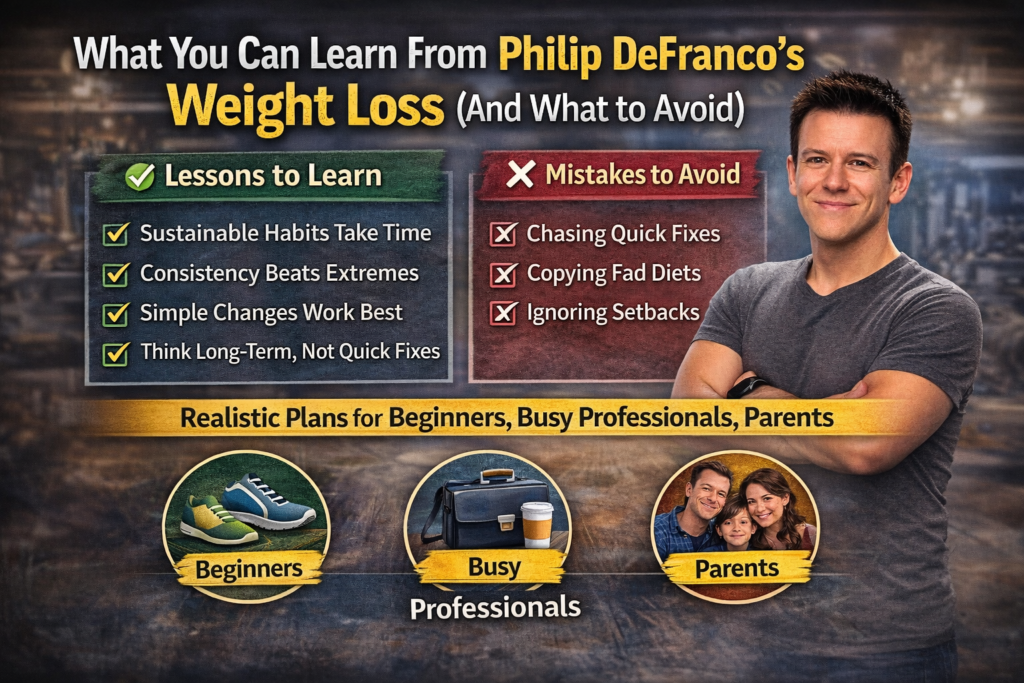
PART 2: Mistakes to Avoid (What NOT to Copy)
Many mistakes come from misunderstanding popular myths surrounding Philip DeFranco’s weight loss. Learning from Philip DeFranco’s journey also means understanding what not to do.
Mistake 1: Chasing Unrealistic Transformations
One of the biggest traps is comparing yourself to:
- Highlight reels
- Extreme before-and-after photos
- Short-term transformations
Philip DeFranco’s journey looked different because it was paced.
Trying to replicate dramatic changes quickly often leads to:
- Burnout
- Frustration
- Abandonment of habits
What to do instead:
Focus on steady improvement, not visual shock value.
Mistake 2: Copying Without Context
It’s tempting to copy:
- Someone else’s routine
- Their schedule
- Their food choices
But Philip DeFranco’s habits worked because they fit his life.
Blind imitation ignores:
- Work hours
- Family responsibilities
- Energy levels
- Personal preferences
What to do instead:
Adapt principles, not exact routines.
Mistake 3: Expecting Motivation to Carry You
Motivation fluctuates. Philip DeFranco didn’t rely on constant enthusiasm — he relied on structure.
Waiting to “feel ready” often delays progress indefinitely.
What to do instead:
Build routines that work even on low-energy days.
Mistake 4: Letting Setbacks Define the Journey
Missed workouts, imperfect meals, and busy weeks didn’t end the journey — they were part of it.
Many people quit after small disruptions because they view progress as fragile.
What to do instead:
Treat setbacks as temporary, not permanent.
Mistake 5: Overvaluing Speed Over Stability
Fast results feel rewarding — but stability is what keeps them.
Philip DeFranco’s visible changes stuck because they weren’t rushed.
What to do instead:
Choose plans that still make sense six months from now.
PART 3: Realistic Plans for Different Audiences
Not everyone has the same schedule, energy, or responsibilities. Below are practical frameworks inspired by Philip DeFranco’s approach, adapted for real people.
Plan 1: Beginners (Starting From Zero)
Who This Is For
- People new to fitness
- Those restarting after a long break
- Anyone feeling overwhelmed
Focus
- Habit formation
- Confidence building
- Reducing pressure
Practical Starting Points
- Walk daily for 20–30 minutes
- Eat regular meals instead of skipping
- Focus on portion awareness
- Drink water consistently
Mindset Shift
Don’t aim for transformation — aim for momentum.
Success looks like:
Showing up more often than not.
Plan 2: Busy Professionals
Who This Is For
- Long work hours
- High stress
- Limited free time
Focus
- Efficiency
- Predictability
- Low-decision routines
Practical Strategies
- Short workouts (20–40 minutes)
- Repeat meals during the workweek
- Schedule workouts like meetings
- Walk during calls when possible
Mindset Shift
Progress doesn’t need to disrupt your career.
Success looks like:
Habits that survive busy weeks.
Plan 3: Parents With Limited Time
Who This Is For
- Parents juggling family and work
- Irregular schedules
- Frequent interruptions
Focus
- Flexibility
- Realistic expectations
- Family-friendly habits
Practical Strategies
- Home workouts
- Active play with kids
- Simple meals for everyone
- Accept shorter sessions
Mindset Shift
Consistency doesn’t mean perfection.
Success looks like:
Doing what’s possible, not ideal.
How to Build Your Own Plan (Inspired by DeFranco’s Journey)
Use these three questions:
1. What Can I Repeat Most Days?
Choose actions that feel doable even when tired.
2. What Adds Energy Instead of Draining It?
Habits should support your day, not fight it.
3. What Still Works When Life Gets Busy?
Stress-tested routines last longer.
Why Sustainability Matters More Than Results
Philip DeFranco’s weight loss worked because it didn’t rely on:
- Constant discipline
- Extreme restriction
- Perfect conditions
Instead, it relied on alignment — habits that fit into his life.
Sustainable change is less about effort and more about design.
The Bigger Lesson: This Wasn’t About Weight Alone
Ultimately, Philip DeFranco’s journey wasn’t just about weight loss.
It was about:
- Energy
- Clarity
- Consistency
- Long-term thinking
The physical change was a byproduct of a lifestyle shift — not the sole objective.
Final Thoughts: What You Should Take Away
Philip DeFranco’s weight loss offers a refreshing counterpoint to unrealistic online narratives.
What to Learn
- Go slow
- Keep it simple
- Build habits around real life
- Think long-term
What to Avoid
- Chasing fast results
- Copying without context
- Letting setbacks derail progress
When you apply these lessons thoughtfully, progress becomes less stressful — and far more sustainable.

After 38 Years of Medical Practice I have started to share insights from my experience over this blog. Know more about me here on About Page and Visit my LinkedIn profile.