
Let me ask you something honest: When did you last go more than five hours without eating — and feel completely fine? No headache. No irritability. No mental fog so thick you could cut it with a knife. If you’re struggling to remember, you’re not alone. I have come across many patients who are facing these. And that struggle is telling you something important.
There’s a concept discussed among exercise physiologists, metabolic researchers, and cutting-edge clinicians who have been quietly discussing for years — and it’s finally making its way into mainstream conversation, thanks to internet and to the curiosity of current generation. It’s called metabolic flexibility. And understanding it might be the single most important thing you do for your long-term health this decade.
Not because it’s a trendy diet like keto or intermittent fasting. Not because some influencer (or popular celebrity weight loss journey like that of Philip DeFranco’s) is hawking it with a discount code. But because it describes something fundamental — a biological capacity that every human being was born with, and that a shockingly large number of us have systematically dismantled through the choices we make every single day.
The Elegant Machine You’ve Forgotten You Own
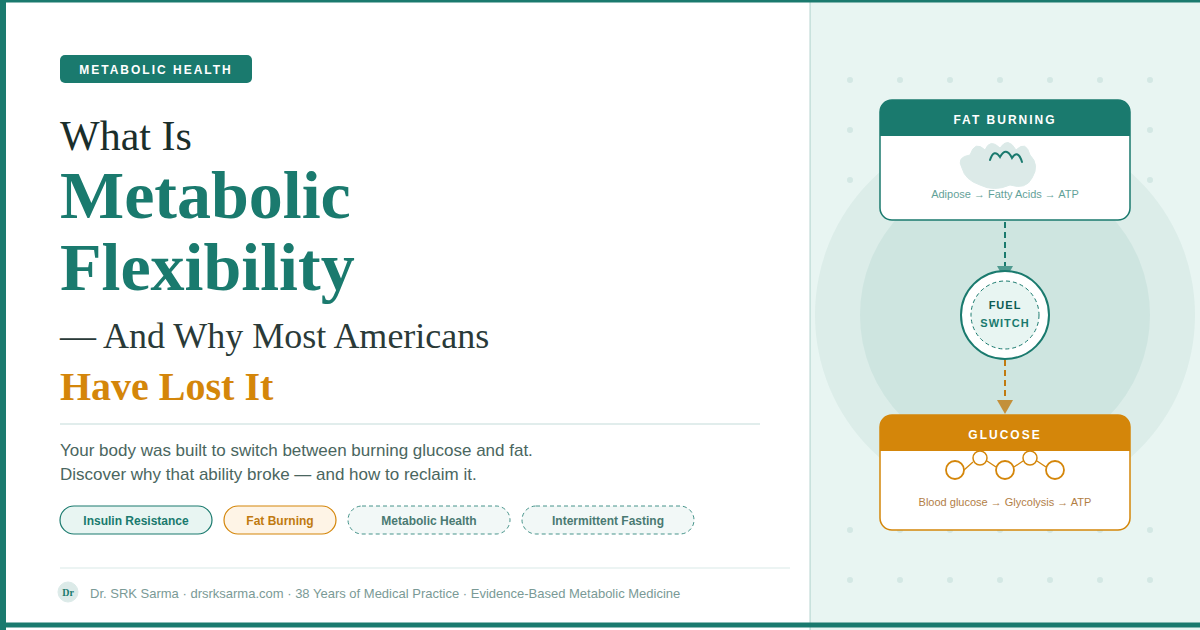
Imagine your body as a hybrid car — one that can run on gasoline (glucose, from carbohydrates) or electricity (fat, stored in your adipose tissue).
In an ideal world, your internal system detects:
a. what fuel is available,
b. what kind of demand you’re placing on the engine,
and makes the switch effortlessly.
Hill climb ahead? Tap the electric reserves. Cruising on the highway? Gasoline works just fine.
That’s metabolic flexibility in a nutshell. It is your body’s ability to efficiently shift between burning carbohydrates and burning fat based on
a. availability,
b. hormonal signals, and
c. physiological need.
A metabolically flexible person can eat a carb-rich meal and process glucose cleanly. They can also fast for 16 hours and seamlessly transition to burning stored body fat — without drama, without suffering, without spiraling into a hypoglycemic panic attack over a delayed lunch.
This isn’t science fiction. This is how humans operated for the vast majority of our evolutionary history (like, approx. 1,00,000 of years we were like that, and agricultural started only around 10,000 years ago). We were hunters and gatherers, feast-or-famine creatures. Our metabolism was designed for variable fuel availability — and it thrived on it.
Metabolic flexibility is not a diet trick. It is the return to a biological baseline your ancestors never had to think about — because modern food hadn’t yet destroyed it.
The Science: What’s Actually Happening Inside Your Cells
To appreciate what metabolic flexibility means, you need a brief tour of your cellular machinery.
Every cell in your body contains mitochondria — those famous “powerhouses of the cell” your biology teacher drilled into you. Their job is to take fuel (whether glucose or fatty acids) and convert it into ATP, the universal energy currency your body spends on everything from heartbeats to conscious thought.
In a metabolically healthy person, mitochondria are remarkably adept at using whichever fuel is most available.
After a carbohydrate-rich meal, insulin rises, signaling cells to take up glucose and burn it. Blood glucose normalizes, insulin drops, and if no more food arrives, the body begins releasing fatty acids from fat stores. Those fatty acids flood the mitochondria and get oxidized for energy. Clean, efficient, seamless.
The regulatory hub of this system is a family of proteins called PPARs (Peroxisome Proliferator-Activated Receptors) and a master metabolic sensor called AMPK (AMP-activated protein kinase). When energy is scarce, AMPK fires up and promotes fat oxidation. When energy is abundant, different pathways activate. Together, these systems create a dynamic, responsive metabolic orchestra. Sounds like lot of medical terms? Let me explain in simpler terms.
But here’s what happens when the orchestra never gets to practice switching tempos: it forgets how. The individual musicians (your cells) become specialized in one mode — glucose burning — and grow increasingly reluctant and unable to pivot. This is metabolic inflexibility. And it sets the stage for a cascade of health consequences that most people attribute to bad genes or bad luck.
Just like, our muscles don’t become strong when we don’t exercise, our cells also lose the ability to switch the modes when such usage becomes rare.
88%of American adults are metabolically unhealthy by at least one measure
70%+of U.S. calories now come from ultra-processed foods
6×more eating occasions per day vs. 50 years ago
How to Know If You’ve Lost It
Before we talk about how most Americans lost metabolic flexibility, let’s get personal. Because the signs are hiding in plain sight — masquerading as normal life when they’re anything but.
- Energy crashes after meals. You eat lunch, and within 90 minutes you’re fighting to keep your eyes open. Your body spiked insulin, cleared the glucose — and now has no graceful way to transition to fat burning, so it panics.
- Can’t skip a meal without misery. Missing lunch makes you shaky, irritable, and unable to concentrate. This is your body signaling it cannot access its own fat reserves efficiently.
- Relentless carbohydrate cravings. You crave sugar and refined carbs — not occasionally, but almost constantly. Your cells are screaming for glucose because that’s the only fuel pathway still working well. Now you got the culprit behind your snack carvings?
- Foggy brain by mid-afternoon. The 3 PM slump is a sign of blood sugar dysregulation, not a coffee deficiency. Your cortisol has dropped, your glucose has dipped, and your fat-burning engine is stalled.
- Weight that won’t budge despite “eating less.” If your body is insulin-resistant and metabolically inflexible, it’s physically difficult to access stored body fat for fuel — regardless of caloric math.
- Waking up exhausted despite adequate sleep. Cortisol and blood sugar dysregulation during the night disrupts sleep architecture in ways you may never consciously register.
- Exercise feels harder than it should. Metabolically inflexible athletes “bonk” early and struggle to train in a fasted state. Their fat-burning machinery is underperforming.
If four or more of these feel uncomfortably familiar — welcome to the club. A club with an estimated 88% membership among American adults, according to research published by the University of North Carolina.
How Modern America Systematically Broke Its Own Metabolism
Here’s where the story gets uncomfortable. Because this isn’t about individual willpower failures.
This is about a food environment, a culture, and an economic system that conspired — however unintentionally — to produce a population of metabolically impaired people.
The Snacking Revolution That Wasn’t Revolutionary
In the 1970s, the average American ate three meals a day, full stop. Today, the average is closer to 6 eating occasions — “meals” blurring into snacks blurring into mindless grazing from morning to night. Every single bite you take stimulates an insulin response. And insulin is the master regulator of metabolic switching.
Here’s the critical thing to understand: as long as insulin is elevated, fat burning is essentially switched off. Your body only accesses stored fat during periods of low insulin — which requires meaningful time between meals. If you’re eating every two to three hours, insulin never truly drops. The fat-burning machinery sits idle. Year after year. And like any machinery that sits idle, it degrades. Just like muscle or our memory, if it is not used regularly, it will diminish.
The Ultra-Processed Food Avalanche
It’s not just when you eat. It’s what you eat. Ultra-processed foods — the kind that arrive in crinkly packaging with ingredient lists that read like a chemistry exam — have a remarkable ability to spike blood sugar rapidly, deliver precisely calibrated combinations of fat and sugar that override satiety signals, and provide almost none of the fiber, micronutrients, and phytochemicals that support healthy metabolic function. No nutrition, only calories.
Refined carbohydrates and added sugars flood the bloodstream with glucose faster than the body can gracefully handle. Insulin surges to compensate. Over time, cells become resistant to insulin’s signal — they’ve heard it too loud, too often, for too long. This is insulin resistance, the metabolic disease of our era, and it is both a cause and consequence of metabolic inflexibility.
⚠ The Invisible Threshold
You don’t have to be diabetic to have impaired metabolic flexibility. Millions of people sit in a gray zone — normal fasting glucose, but elevated fasting insulin — where fat-burning is chronically suppressed, energy is unstable, and the risk of type 2 diabetes, cardiovascular disease, and cognitive decline is quietly accumulating.
The Sedentary Catastrophe
Movement is one of the most powerful activators of metabolic flexibility. When you exercise — especially at moderate intensity — your muscles activate AMPK, the energy sensor that promotes fat oxidation. Your cells upregulate mitochondrial density and improve their insulin sensitivity. Your body gets better at burning fat.
The average American now spends more than 10 hours per day sitting. We drive to work, sit at desks, drive home, and sit on the couch. Without the regular metabolic stimulus of movement, the fat-burning machinery rusts from disuse. Muscles that once eagerly oxidized fatty acids become glucose-dependent, inflexible, and insulin resistant. The downstream effects are profound.
Chronic Sleep Deprivation: The Overlooked Metabolic Wrecker
Sleep is when your body performs much of its metabolic maintenance — clearing cellular debris, balancing hormones, regulating insulin sensitivity. Even a single night of poor sleep measurably impairs glucose metabolism and insulin sensitivity.
Chronically sleeping fewer than seven hours a night (as roughly 35% of Americans do) keeps cortisol chronically elevated, disrupts leptin and ghrelin (hunger hormones), and impairs the very cellular pathways that enable efficient fuel switching.
You can eat perfectly and exercise religiously, but if you’re consistently sleeping five or six hours, your metabolic flexibility will remain compromised. Sleep is not optional maintenance. It is fundamental infrastructure.
Chronic Stress: When Your Fight-or-Flight Hijacks Your Metabolism
Cortisol — your primary stress hormone — is a potent glucose mobilizer. In a genuine emergency, this is life-saving: your body dumps glucose into the bloodstream to fuel your muscles for fight or flight.
But in the context of modern psychological stress (deadline pressures, financial anxiety, relationship conflict, doomscrolling at midnight), cortisol keeps firing — chronically elevating blood glucose, chronically stimulating insulin, and chronically suppressing the fat-burning pathways that require low insulin to operate.
Chronic stress doesn’t just affect your mood. It physically rewires your metabolism, reinforcing the glucose-burning rut and making the shift to fat oxidation progressively harder.
You cannot out-eat, out-exercise, or out-supplement a chronically stressed nervous system. The metabolic consequences of unmanaged stress are as real as any poor dietary choice.
Why This Matters Beyond Energy Levels
At this point you might be thinking: “Okay, I get groggy after lunch. So what?” The stakes are considerably higher than afternoon drowsiness. Metabolic inflexibility is not merely inconvenient — it is increasingly recognized as a root driver of many of the chronic diseases defining modern medicine.
High Risk of Diabetes: Research has linked impaired metabolic flexibility with the development of type 2 diabetes, as the inability to efficiently switch fuel sources accelerates insulin resistance progression.
Impact on Heart: The cardiovascular system suffers when triglycerides remain elevated from impaired fat oxidation, and when chronic low-grade inflammation — a hallmark of metabolic dysfunction — damages arterial walls.
Impact on Brain: The brain, which is paradoxically one of the most metabolically demanding organs in the body, appears to be particularly vulnerable to impaired fuel utilization, with emerging research suggesting links between metabolic inflexibility and Alzheimer’s disease — now sometimes called “type 3 diabetes” in scientific literature.
Increased Risk of Cancers: Even cancer risk may be influenced: some research suggests that chronically elevated insulin and glucose create a metabolic environment favorable to cancer cell proliferation, since many cancers are obligate glucose consumers.
Effect on Fertility: The fertility implications of metabolic dysfunction — particularly in polycystic ovary syndrome (PCOS), which is driven in large part by insulin resistance — affect millions of women.
Effect on Immunity: And the immune system functions less precisely in a metabolically dysregulated environment, contributing to the chronic inflammatory conditions that now account for the majority of global disease burden.
This is not catastrophizing. This is the consensus of a growing body of rigorous research. Metabolic flexibility is not a wellness trend. It is a fundamental biomarker of biological health.
The Road Back: Restoring What Was Lost
Here is the genuinely good news: your metabolism is not irrevocably broken. The same plasticity that allowed it to become inflexible means it can be retrained. The cellular machinery can be restored. The pathways can be rebuilt. But it requires patience, consistency, and a willingness to be uncomfortable — at least temporarily.
1. Create Windows Without Food
The most direct way to restore fat-burning capacity is to give it a reason to work again — which means allowing insulin to drop sufficiently between meals. You don’t need to jump straight into a 72-hour fast.
Start with a 12-hour overnight fast (finish dinner by 7 PM, don’t eat until 7 AM). Gradually extend to 14 or 16 hours if tolerated. The initial discomfort — mild hunger, some brain fog — is not dangerous.
It is your metabolism attempting to access fat stores for the first time in a long time. It’s the sensation of unused machinery creaking back to life.
2. Reduce Dietary Glycemic Load
You don’t need to go full ketogenic (though some do and thrive). But substantially reducing your intake of refined carbohydrates and added sugars — the foods that spike blood glucose and insulin most aggressively — is non-negotiable for metabolic recovery.
Replace processed grains with whole food carbohydrates paired with fiber, protein, and fat. These combinations slow glucose absorption, moderate insulin response, and give your metabolic switching system a gentler operating environment to relearn its craft.
3. Prioritize Protein at Every Meal
Protein is the most satiating macronutrient. It supports lean muscle mass — your body’s most important metabolic organ — and has a modest insulin response compared to carbohydrates.
Aiming for 30–40 grams of quality protein at each major meal reduces carbohydrate cravings, supports blood sugar stability, and gives your metabolism the building blocks it needs for cellular repair and mitochondrial function.
4. Move — Especially After Meals
A 10-minute walk after eating is one of the most underrated metabolic interventions in existence. It activates GLUT4 transporters in muscle cells — pathways that allow glucose to be taken up without insulin — blunting the post-meal glucose spike dramatically.
Regular resistance training builds the metabolic muscle tissue that acts as a glucose sink and fat-burning engine. Even moderate increases in daily movement dramatically accelerate the restoration of metabolic flexibility.
- Research finds that 10-minute walk after meals is lot beneficial than 30-minute walk at random times.
5. Sleep Like Your Metabolism Depends on It (It Does)
Seven to nine hours of quality sleep in a cool, dark room is not a luxury recommendation. It is a metabolic prescription. If sleep is compromised, every other intervention will be uphill.
Address sleep apnea if present, establish consistent sleep-wake times, and treat light and screen exposure in the evening as seriously as you would a dietary choice.
6. Manage Stress with the Same Rigor as Diet
Breathwork, meditation, nature exposure, genuine social connection, therapy — these are not soft add-ons. They are metabolic interventions that lower chronic cortisol, improve insulin sensitivity, and create the hormonal environment in which fat oxidation can flourish. The most beautifully curated diet plan will underperform in a chronically stressed nervous system.
Lowering chronic cortisol –> Improvement in insulin sensitivity –> Improves Fat Oxidation
The Bottom Line You Deserve
You were born metabolically flexible. Your ancestors depended on it to survive winters, droughts, and the days between successful hunts. That capacity is still encoded in your biology — waiting, impatiently, to be reactivated.
- It takes months of consistent efforts to unlearn years of bad habits trained to our body.
The modern food environment didn’t steal your metabolic flexibility maliciously. It did so through a thousand small conveniences: the granola bar at 10 AM, the drive-through at lunch, the mindless snacking while streaming at night, the six hours of sleep, the desk-bound days.
Each one alone is trivial. Together, they constitute a decades-long experiment in metabolic suppression.
Reclaiming your metabolic flexibility isn’t about perfection.
It’s about reclaiming your body’s right to function as it was designed to function.
To draw on fat reserves without suffering.
To think clearly without constant feeding.
To wake up with energy that doesn’t require a three-shot espresso to fabricate.
That body is still yours. The question is whether you’re willing to do the unglamorous, consistent work of inviting it back.
Your Questions, Answered
A metabolically flexible person can efficiently use glucose after a meal and transition to burning stored fat during fasting or exercise — without energy crashes, brain fog, or intense hunger.
Think of it as your internal fuel-switching system working the way it was designed to.
energy crashes after meals,
intense carbohydrate cravings,
inability to skip a meal without feeling shaky or irritable,
difficulty losing weight despite caloric restriction,
brain fog in the mid-afternoon,
dependence on caffeine to function,
poor sleep quality, and
feeling sluggish in the morning.
If you relate to four or more of these, your metabolic flexibility likely needs attention.
These patterns keep insulin chronically elevated, prevent the body from ever tapping into fat stores, and ultimately impair the cellular machinery needed to switch fuel sources.
It’s not one single cause — it’s the compounding effect of modern life on ancient biology.
Full metabolic flexibility — where the body efficiently switches between fuel sources and fat-burning is robust — can take 3 to 6 months of sustained effort, though individual results vary based on starting point, degree of insulin resistance, and consistency.
The discomfort at the beginning is real but temporary.
By extending the window between meals, you allow insulin levels to drop sufficiently for your body to transition into fat-burning mode (lipolysis).
Over time, this repeated practice trains your metabolic machinery to make that switch more efficiently and with less discomfort.
You don’t need aggressive fasting windows to start — a consistent 12-hour overnight fast is enough to begin the process.
Metabolic health is more accurately measured by markers like fasting insulin, fasting blood glucose, triglycerides, HDL cholesterol, and waist circumference — not just the number on the scale.
Many lean people are metabolically impaired and don’t know it.

After 38 Years of Medical Practice I have started to share insights from my experience over this blog. Know more about me here on About Page and Visit my LinkedIn profile.